| 1 |
Lost, stolen, or shared access cards |
Former employees, visitors, or contractors retain cards or lend them to another person. |
High |
Unauthorized entry, asset loss, and weak accountability. |
Ensure every credential is assigned to one identifiable person and can be revoked quickly. |
Use photo-linked credentials, immediate deactivation, anti-passback rules, and periodic card audits. |
Deactivation completed within 15 minutes of approved notification; zero active cards for departed users. |
| 2 |
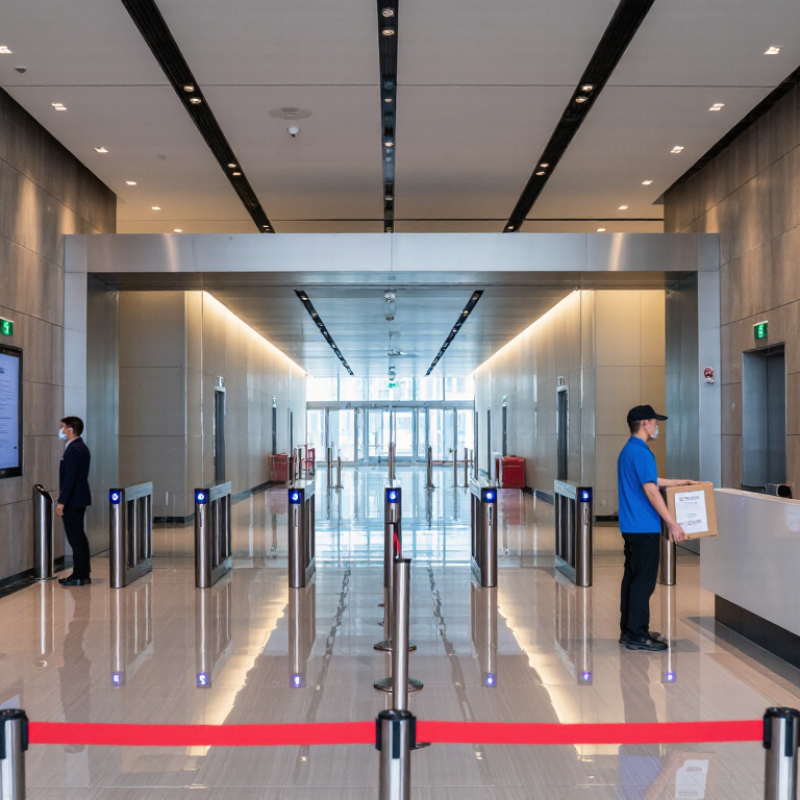
Tailgating and piggybacking |
An unauthorized person follows an authorized user through a controlled door or turnstile. |
High |
Direct bypass of access controls and reduced incident traceability. |
Verify each person entering a restricted area. |
Install speed gates or mantraps where justified, use door-held-open alarms, improve reception procedures, and provide staff awareness training. |
Tailgating events per 1,000 entries; percentage of alarm events reviewed within one business day. |
| 3 |
Weak visitor management |
Visitors enter without identity verification, host approval, escorting, or time-limited credentials. |
High |
Uncontrolled movement, privacy exposure, and difficulty investigating incidents. |
Know who is in the building, why they are present, and when their access ends. |
Use reception screening, host confirmation, visitor badges, escort requirements, sign-in records, and automatic badge expiry. |
100% of visitors linked to a host and recorded entry and exit times. |
| 4 |
Access rights not removed after role changes |
Employees transfer departments, locations, or responsibilities while old permissions remain active. |
High |
Excessive access to offices, data rooms, laboratories, or operational areas. |
Apply least privilege and maintain access according to current job responsibilities. |
Connect access reviews with human-resources workflows, require manager approval, and conduct quarterly entitlement reviews. |
Percentage of access rights reviewed quarterly; number of unnecessary permissions removed. |
| 5 |
Unsecured emergency and service entrances |
Fire exits, loading bays, parking access points, or maintenance doors are left open or poorly supervised. |
High |
Unauthorized entry, theft, safety incidents, and possible interference with emergency routes. |
Keep emergency routes usable while preventing misuse of non-public entrances. |
Use door-position sensors, local alarms, CCTV coverage, security patrols, self-closing hardware, and documented emergency overrides. |
Number of doors held open beyond the approved threshold; alarm response time. |
| 6 |
Credential cloning or misuse |
Older or poorly protected credentials may be copied, intercepted, or used by someone other than the owner. |
Medium–High |
Covert entry and unreliable attribution of access events. |
Use credentials that are difficult to duplicate and reliably tied to the authorized user. |
Adopt secure cryptographic credentials, protect readers and controllers, combine credentials with a second factor for sensitive zones, and investigate unusual usage patterns. |
Number of suspected duplicate credentials; percentage of high-risk doors using multi-factor authentication. |
| 7 |
Failure of access-control systems or communications |
Power loss, network interruption, controller faults, or software errors affect doors and monitoring. |
Medium–High |
Doors may become inaccessible, remain unlocked, or lose event records. |
Maintain secure operation and auditable records during predictable outages. |
Provide backup power, local controller decision-making, protected network connections, tested fail-safe or fail-secure settings, and recovery procedures. |
System availability; recovery time; percentage of backup systems tested according to schedule. |
| 8 |
Insufficient protection of sensitive areas |
Server rooms, archives, control rooms, laboratories, and executive areas use the same controls as ordinary spaces. |
Medium–High |
Higher-value assets or critical operations may be exposed. |
Match access strength to the sensitivity and consequence of each area. |
Classify zones, use layered access, require stronger authentication for critical rooms, maintain access logs, and restrict access to named roles. |
Percentage of sensitive zones with documented risk ratings and approved access lists. |
| 9 |
Insider misuse and unauthorized escorting |
An authorized person deliberately or unintentionally grants access to restricted areas. |
Medium |
Loss of confidential information, equipment, or operational control. |
Make access decisions accountable and detect abnormal behavior without relying on a single control. |
Separate approval and administration duties, use role-based permissions, review logs, enforce escort rules, and provide security training. |
Percentage of privileged access events reviewed; number of policy violations and resolved corrective actions. |
| 10 |
Incomplete access logs and slow incident response |
Entry events are not synchronized, retained, reviewed, or linked with video and alarm information. |
Medium |
Delayed detection, weak investigations, and limited legal or operational evidence. |
Detect, investigate, and document unauthorized access in a timely manner. |
Synchronize system clocks, protect audit logs from alteration, define retention periods, integrate alarms with video where appropriate, and maintain an incident-response procedure. |
Percentage of critical events investigated within the defined service level; log completeness and retention compliance. |
 SMTR SmartLiving